
Drug abuse is a serious social problem worldwide. In Japan, the abuse of stimulants (methamphetamine) is still continuing, and the number of abuser of cannabis, narcotics and psychotropics are on the increase. Psychotropics and some of the pharmaceuticals are also used for harm victims of homicide, robbery and sexual assault and the crimes becoming more atrocious. This section is responsible for research on the analysis of controlled drugs, forensic toxicology and related caseworks.
Research and development of drug analysis
Analytical methods have been developed for identifying various types of drugs, including those expected to be abused in the future, using the latest analytical technologies. The drug characterizations of methamphetamine and other drugs have been also studied for identifying the sources of supply and trafficking routes (Drug profiling).
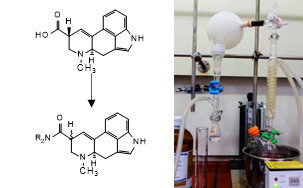
Synthesis of analytical standards (drugs and its metabolites).
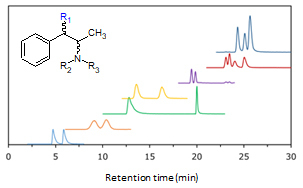
Simultaneous chiral separation of methamphetamine and related compounds with high performance supercritical fluid chromatograph – mass spectrometer.
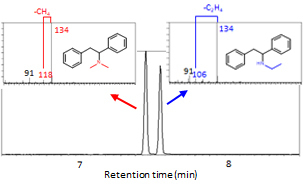
Identification of structural isomers of new psychoactive substances with a gas chromatograph - mass spectrometer
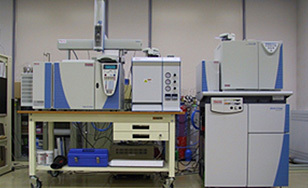
Stable isotope ratio mass spectrometer (lower-right) and the peripherals.
Drug profiling is conducted based on combination of the impurity profiles using gas chromatography, chirality and the stable isotopic compositions.
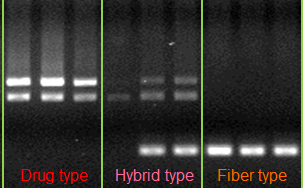
Cannabis profiling using genetic information.
Study on drug disposition
To demonstrate drug abused or drug-committed crimes , it is necessary to understand the drug disposition. A study of the absorption, distribution, metabolism and excretion of abused drugs has been conducted.
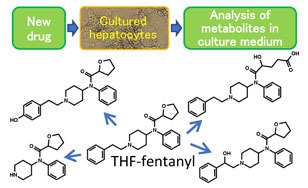
Drug metabolism study using cultured hepatocytes.
(Figure: Metabolic pathway of synthetic opioid THF-fentanyl.)
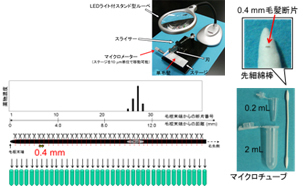
Drug-distribution measurement in a hair.
A method for visualizing the distributions of drug in hair by segmenting a single hair strand at a 0.4-mm interval, which corresponds to the average 1-day growth length of hair strands, has been developed.
The method has been applied to elucidate the mechanism of drug uptake into hair and to accurately estimate the day of drug intake.
