Police officers in the juvenile policing divisions engage in both cracking down on juvenile crime and interventions for delinquents to recover good adjustments.
We investigate how interventions of police officers curb deviant behavior of juveniles, in order to reveal the most effective interventions.

The Juvenile Section is responsible for conducting studies on the causes and backgroudns of unlawful behavior of young people, effective measures against juvenile delinquency, and preventive measures against juvenile victimization.
Research on interventions of police officers for juvenile delinquents
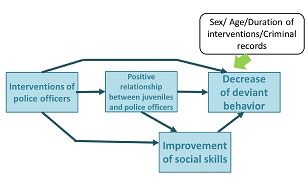
A process of decrease of deviant behavior by intervention of police officers
Investigative interviewing of child victims: A behavioral science approach
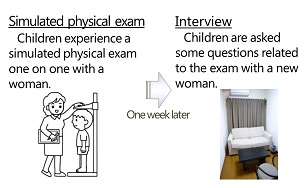
An experiment to examine interview techniques to elicit information from children
The number of child victims treated by the police is increasing these days, and it is important to obtain accurate information from children about victimization.
Interview methods to elicit information from children are examined based on surveys, experiments and statistical analyses in this study.
